
This recipe is more about survival cooking than it is about everyday cooking. In the recipe below, I try to provide a brief methodology for cleaning and cooking a snake.
Snakes are eaten in various forms across the globe, although they are a rarity in the West. You still find some folks in the U.S. who will clean and prepare wild rattlesnakes, on occasion.
The quantity of meat is meager, and the rib bones are bountiful. But if you find yourself in a situation where you need to clean & prepare a rattlesnake, please read on:
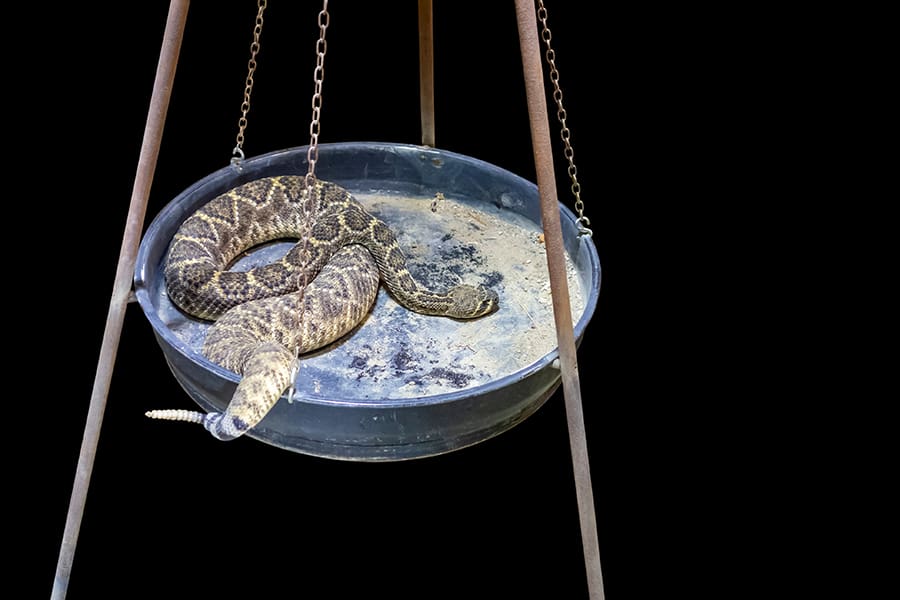
How to Cook a Rattlesnake
This recipe is more about survival cooking than it is about everyday cooking. In the recipe below, I try to provide a brief methodology for cleaning and cooking a snake. Snakes are eaten in various forms across the globe, although they are a rarity in the West. You still find some folks in the U.S. who will clean and prepare wild rattlesnakes, on occasion. The quantity of meat is meager, and the rib bones are bountiful. But if you find yourself in a situation where you need to clean & prepare a rattlesnake, please read on:
Ingredients
- 1 5-6 foot-long healthy, (chilled wild rattlesnake)
- 2 shallots, (finely minced)
- 2 cloves garlic, (finely minced)
- Zest of 1 lime
- Juice of 1 lime
- 1.5 Tbsp kosher salt
- 2 tsp red pepper flakes
- 6 whole eggs, (whisked)
- 2 cups fine seasoned breadcrumbs
- 3 cups vegetable oil, ( or sunflower oil)
- Kosher salt, ( to sprinkle on snake after frying)
Instructions
- Lay the snake out on an extra-large cutting board or cleaned surface.
- Cut the head off the snake using a sharp knife and discard.
- Flip the snake onto its back, exposing the belly.
- Take a sharp pair of kitchen scissors, and make a cut starting at the back-end of the snake, making a cut starting at the anus of the snake, cutting carefully upwards along the middle of the belly all the way up through the head section at the top.
- Carefully peel the snake skin off of the top section of the snake, peeling back the skin with your fingers until you separate the skin from the top two inches of the snake flesh nearest the head.
- Grab the separated section of skin you just pulled back firmly with one hand, and grab the snake flesh firmly with the other hand, and carefully peel the skin off from the flesh, separating the connective tissue that holds the skin to the snake flesh.
- Once you have removed the skin, set aside and preserve if you desire.
- *There are many approaches to preserving rattlesnake skin, which has many uses once properly cured and dried.
- Now that the skin has been removed, carefully use one hand to remove the guts, intestines, and organs from the snake, which should come out intact if you pull it away carefully while gripping the flesh and rib section.
- Discard the innards.
- Clean the inside of the snake under water once all of the innards are removed.
- Dry the snake completely with paper towels.
- Cut the meat (with the rib bones) into sections roughly 4 inches long and set aside on paper towels while you prepare your rattlesnake marinade.
- For the rattlesnake marinade, combine the minced shallot, minced garlic, lime zest, lime juice, olive oil, kosher salt, and red pepper flakes and mix together.
- *Some people enjoy some Old Bay Seasoning here.
- Combine the marinade with the snake meat and allow to sit for roughly 4 hours.
- Remove the snake meat from the marinade and allow the marinade to drain off.
- Dry off the snake meat a bit with some paper towels. Don’t worry if some of the marinade is still sticking to the snake pieces.
- Heat vegetable oil to 380F (hot!) in a pan with high sides that is suitable for frying.
- *The oil is really hot here because the snake cooks quickly.
- Lightly coat the snake meat with the whisked eggs, completely drain off any excess egg wash, and coat the snake pieces all-over with the seasoned breadcrumbs.
- Fry the snake pieces quickly, until they turn a very light golden color.
- *Do not cook to golden brown, as the snake will be overcooked. You want your end-product to be barely golden.
- When the snake pieces are just out of the fryer and draining on paper towels, season with some salt, and enjoy hot.
- *Note, there are a lot of bones!
Notes
You need to be really careful when dealing with cooking snakes, especially if there is any concern that the animals might have consumed rodents that were poisoned or working with snakes that have not been refrigerated promptly & properly after being killed.
In this sense, it is best to speak with a knowledgeable expert (in regions where this is possible) about the best means to acquire and safely consume a wild rattlesnake.
In this sense, it is best to speak with a knowledgeable expert (in regions where this is possible) about the best means to acquire and safely consume a wild rattlesnake.