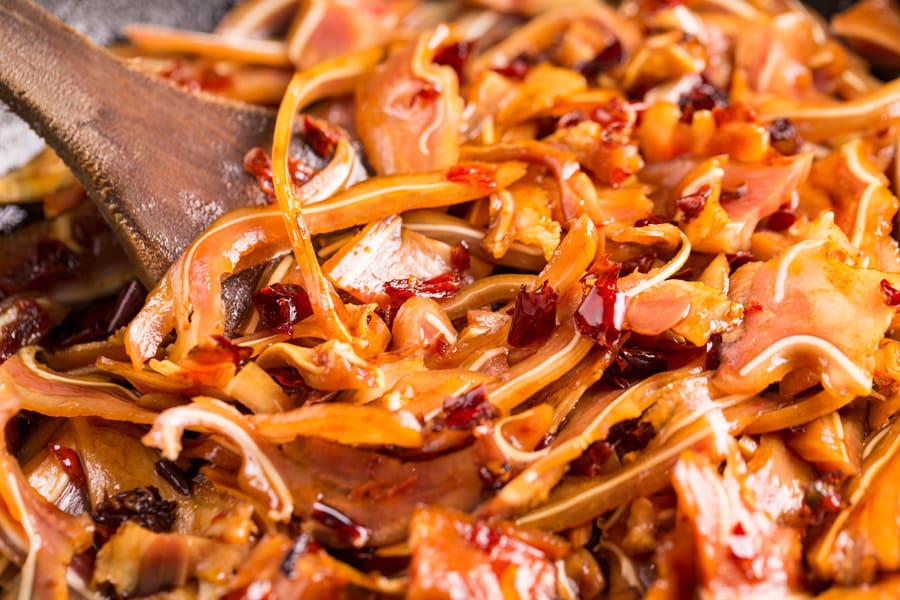
Slow Braised Pig Ears with Spicy Pork & Apple Cider Mustard Sauce over Pasta
I spent four months working at a restaurant in Tennessee where they served a crispy pig ear salad. The pig ears were cooked sous-vide (in plastic bags, under water) in a little bit of bacon fat for eight hours. The ears were then sliced thin, coated in corn starch, and deep-fried. I really appreciated learning the technique of deep-frying the ears after they had been cooked and sliced, but I found that the cartilage in the ear can take even longer than eight hours to really soften up. Maybe I just prefer my pig ears to be cooked longer than other people. For this recipe, I start with some unsalted store-bought stock, and fortify it with some extra mirepoix and pork bones while cooking pig ears in the broth for 14 hours. Not only do you get some of the most flavorful pork stock ever, you also have two beautifully soft pig ears to eat for dinner. They are so soft that you can cut them easily with a spoon.Use a small amount of the pork stock cooking liquid to make a spicy apple cider mustard sauce, and toss the sauce with some cooked pasta. Serve pasta with the pig ears, parmesan cheese, and fresh parsley. The recipe below is intended for roughly 2 portions, with one pig ear per serving.
Ingredients
For the Pig Ears & Stock:
- 2-3 quarts unsalted pork, beef, or chicken stock
- 2 large onions, roughly chopped
- 4 carrots, roughly chopped
- 4 stalks celery, roughly chopped
- 4 bay leaves
- 24oz pork bones, including trotters & spine
- 2 pig ears
For the Spicy Pork & Apple Cider Mustard Sauce:
- ¾ cup pork stock, from what you made while cooking the pig ears
- ¼ cup apple cider
- 1 Tbsp corn starch
- 1 Tbsp cold water
- 2 Tbsp cold butter
- 1.5 Tbsp honey
- 1 Tbsp Dijon mustard
- 1 tsp red pepper flakes
- ¼ tsp cayenne pepper
- 2 Tbsp stone-ground mustard
- 2 tsp apple cider vinegar
- Kosher salt & freshly-ground black pepper, to taste
For the Pasta:
- 6oz dried pasta
- 1oz parmesan cheese, freshly grated
- 3 Tbsp fresh parsley, roughly chopped
Instructions
For the Pig Ears & Stock:
- Combine 2 quarts unsalted pork, beef, or chicken stock with the onions, carrots, celery, bay leaves, pig ears, and pork bones and bring to a simmer.
- Cook on low heat at right below a simmer for roughly 14 hours, making sure to keep the pig ears submerged as they cook.
- If you need to add more liquid to keep the pig ears submerged as the stock reduces, add some more stock and continue to cook under the pig ears are incredibly soft and tender.
- *If you layer the ears in the cooking pot underneath the pork bones, you can use the bones as a weight to keep the ears from floating to the top while they cook.
- When the pig ears are done cooking, remove them from liquid and strain out the stock.
- Reserve ¾ cup of the pork stock for use in your sauce for later.
- Cool the remaining pork stock down in the fridge or freezer and save for whenever you want to use it down the road.
For the Spicy Pork & Apple Cider Mustard Sauce:
- Combine ¾ cups of pork stock with ¼ cup apple cider in a small sauce pot on the stove.
- Bring to a boil and reduce the heat to low.
- Combine 1 Tbsp corn starch with 1 Tbsp cold water, and mix with a fork until the mixture is the thickness of heavy cream or whole milk.
- Pour the starch mixture into the boiling stock and apple cider, whisking until the mixture thickens.
- Make sure to whisk to avoid any lumps of starch in the sauce.
- If you want your sauce to be even thicker, you can continue to reduce it over medium-low heat, or you can simply whisk in a bit more cornstarch mixed with water until you reach your desired sauce consistency.
- When you are satisfied with the consistency of your sauce, add in the 2 Tbsp cold butter and stir until the butter has been incorporated into the sauce.
- If your sauce at this point has any lumps, don’t fret.
- Simply strain it through a fine mesh strainer into a bowl and then proceed to add the remaining sauce ingredients.
- Add the honey, Dijon mustard, red pepper flakes, cayenne pepper, stone-ground mustard, and apple cider vinegar, and stir until combined.
- Taste sauce and season with kosher salt & freshly-ground black pepper.
- Keep sauce gently warm while you prepare you pasta.
For the Pasta:
- Bring a large pot of salted pasta water to a boil.
- Add the dried pasta and cook until done.
- While the pasta is cooking, warm up your sauce that you made earlier.
- One minute before your pasta is done cooking, add the soft pig ears you cooked earlier to the boiling pasta water.
- *This is just to warm to pig ears back up so you can serve them hot.
- When pasta is done cooking, drain pasta and mix pasta in a bowl with the warm sauce.
- Serve the sauced pasta up on plates with the warm pig ears on top.
- Garnish with freshly-grated parmesan cheese and fresh parsley.
Notes
I will often use a day of cooking pig ears as an excuse to make a large batch of pork stock.
Feel free to go ahead and eat the entire pig ear. Personally, I discard the thickest 10% of the ear (closest to the head) after it is cooked, because I prefer to eat the thinner section of the ears.
Feel free to go ahead and eat the entire pig ear. Personally, I discard the thickest 10% of the ear (closest to the head) after it is cooked, because I prefer to eat the thinner section of the ears.